
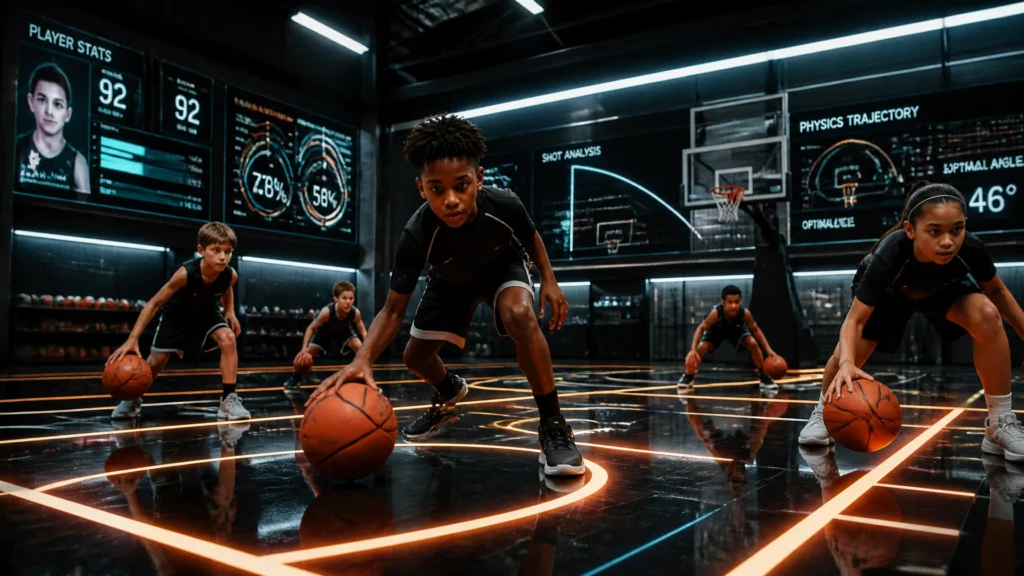
Helping a child pick up a basketball for the first time is about more than just teaching them how to put a ball through a hoop. At Sports Media Inc., we see youth sports as the primary engine for the future Fortune 100 talent funnel. When a child learns the rhythm of a dribble or the physics of a shot, they are developing the spatial awareness, analytical thinking, and teamwork required for a modern, STEM-driven workforce.
The basketball court is essentially a giant laboratory for logic, physics, and system optimization. By integrating these high-level concepts into early training, we prepare the next generation for the infrastructure of the future, whether that is in a physical stadium or a high-tech Esports Pod. To help you get started, we have compiled fifteen essential drills that combine fundamental skills with the building blocks of workforce readiness.
The Foundation of Ball Handling: Algorithms and Logic
Dribbling is the most basic form of data processing on the court. It requires constant feedback loops between the eyes, the hands, and the brain.
1. Cone Zig-Zag Dribble (Algorithms on the Court)
Set up five to seven cones in a line about three feet apart. Have your child dribble through the cones using their right hand down the line and their left hand back. This drill is a physical algorithm. It is a step-by-step path with specific rules. By mastering the sequence, children learn how to follow complex instructions, a vital skill in any engineering or coding environment.
2. Heads-Up Reaction Dribble (Conditional Logic)
In this drill, the player dribbles while watching a coach or parent. The coach shows silent signals, such as one finger for a crossover or a hand up for a stop. This introduces "if-then" logic. If the signal is X, then the player must perform Y. This mirrors the conditional logic used in software development and advanced data analytics.
3. Two-Ball Dribbling (Parallel Processing)
Dribbling two balls at once is the ultimate test of coordination. It forces the brain to handle multiple tasks simultaneously. In the tech world, we call this parallel processing. Developing this ability early helps children manage complex projects and high-pressure environments where multi-tasking is a necessity.
4. Dribble Tag (System Dynamics)
Mark a small area and have multiple kids dribble while trying to knock each other's balls away. This is a study in system dynamics. Many moving parts are interacting at once, and the child must navigate this chaotic system while maintaining their own "data stream" (the ball).

Precision and Physics: The Art of the Shot
Every shot is a lesson in projectile motion. Understanding the variables of force and angle is the first step toward a career in STEM.
5. Form Shooting Close to the Basket (Projectile Motion)
Have your child stand three feet from the hoop and shoot slowly, focusing on their elbow and wrist follow-through. This is the baseline for projectile motion. You can discuss how a higher arc or lower arc changes the trajectory. For a deeper dive into how this tech is used in modern stadiums, check out our solutions page.
6. One-Hand Form Shooting (Variable Testing)
Shooting with one hand forces the player to isolate the primary variable: the shooting arm. By changing the force or the angle of the wrist flick, the child can see immediate changes in the output. This is the scientific method in action.
7. Mikan Layup Drill (Patterns and Symmetry)
Stand under the hoop and alternate right-hand and left-hand layups in a steady rhythm. This drill teaches symmetry and mathematical patterns. Rhythm and consistency are the hallmarks of successful infrastructure management.
8. Bank-Shot Spot Shooting (Geometry and Reflections)
Shooting from the wing and using the backboard introduces geometry. The angle of incidence equals the angle of reflection. This is the same principle used in fiber optics and laser technology.

Strategic Movement and Defensive Logic
Defense is not just about effort; it is about spatial geometry and relative motion. These skills are critical for logistics and strategic planning.
9. Cone Layup Footwork (Sequence Logic)
Placing a cone as a trigger for a specific footwork sequence (left, right, jump) teaches children that order matters. In any talent funnel, understanding the sequence of operations is what separates a professional from an amateur.
10. Partner Passing Series (Vectors and Accuracy)
A pass is a vector. It has a direction and a magnitude. Whether it is a chest pass or a bounce pass, the child must calculate the speed and force required to reach a moving target. This is the same math used in global logistics and media buying.
11. Wall Passing (Timing and Signals)
Using a wall to practice quick-fire passes helps develop a sense of rate and rhythm. You can even time how many passes they can make in thirty seconds to introduce concepts of frequency and signal processing.
12. Mirror Defense Slide (Coordinate Grids)
In this drill, a defender must "mirror" the movements of an offensive player. This teaches them to view the court as a coordinate grid where their position is a reflection of another point in space.
13. Zig-Zag 1v1 Defense (Relative Motion)
Defending a dribbler in a zig-zag pattern up the court requires an understanding of relative motion. The defender is not moving in a vacuum; they are moving in relation to another body. This is a core concept in physics and advanced robotics.
14. Box-Out Rebounding (Leverage and Center of Mass)
Rebounding is all about leverage. By staying low and keeping a wide base, a child learns how to use their center of mass to maintain their position. These principles of mechanics are foundational for future engineers and builders.
15. Continuous Passing Relay (Network Optimization)
This drill treats the team like a network. Passes are data moving through nodes (the players). The goal is to move that data to the "terminal" (the basket) as efficiently as possible without any "traffic jams."

Building the Talent Infrastructure
At Sports Media Inc., we are committed to building the infrastructure that supports these "Future Champions." From interactive digital kiosks in stadiums to the integration of Esports and NIL platforms, we are bridging the gap between traditional physical activity and digital workforce readiness.
The skills learned through these basketball drills are the same skills needed to thrive in high-stakes corporate environments. We are not just training athletes; we are developing the strategic thinkers who will lead the Fortune 100 companies of tomorrow.
To see these drills in action and explore more ways to get your child active, check out our "How to learn and play Sports" YouTube Kids playlist. It is a fantastic resource for parents looking to integrate high-quality sports instruction into their child's daily routine.
Watch the playlist here: Sports Media Kids: Learn and Play Basketball
Whether your child is destined for the NBA or the boardroom, the court is where it all begins. Let's get them in the game today.
Fortune 100 Talent Funnel & Infrastructure Hooks
Hook 1: The Modern Classroom is a Court
The traditional classroom is evolving. To build a Fortune 100 talent funnel, we must look at sports infrastructure like Esports Pods and interactive gyms. These are the new laboratories for STEM readiness and workforce development. #STEM #TalentFunnel #SportsMedia
Hook 2: Esports Pods: The Future of Education Infrastructure
Why are we building Esports Pods? Because they are the ultimate training ground for digital literacy, strategic teamwork, and high-pressure decision-making. This is where the next generation of engineers and analysts are being forged. #Infrastructure #Esports #FutureOfWork
Hook 3: Decoding the Athlete Talent Funnel
A child mastering a "pizza stance" in skiing or a "crossover" in basketball is actually mastering logic and physics. We are leveraging these passion points to feed the STEM workforce pipeline. The funnel starts on the field. #WorkforceDevelopment #STEMEducation
Hook 4: Investing in Future-Ready Stadiums
Stadiums are no longer just for viewing; they are for learning. Our Junior Fan Zones and interactive kiosks are designed to engage kids with technology while they watch their heroes. This is strategic infrastructure for community-wide STEM growth. #StadiumTech #FanEngagement
Hook 5: From the Gym to the Boardroom
Teamwork is the most valuable currency in the Fortune 100. By investing in youth sports programs and high-tech training infrastructure, we are ensuring our future leaders have the soft skills and technical grounding to succeed. #Leadership #TalentInfrastructure #SportsMarketing