
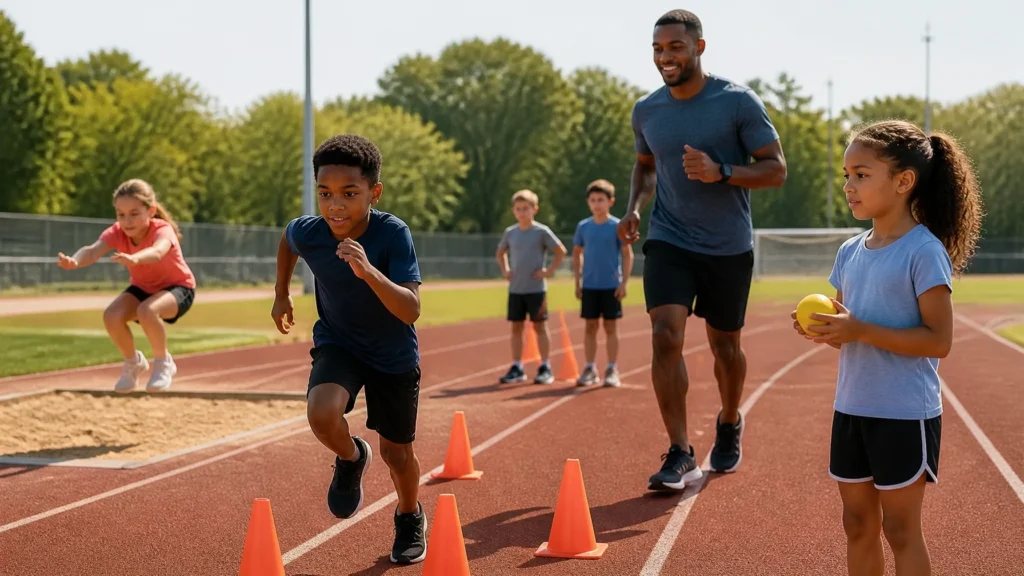
The starting line is not just a place to race. It is a launchpad for confidence, coordination, curiosity, and a lifelong love of movement. That is why youth sports education should begin with simple fundamentals, plenty of encouragement, and activities that make kids want to come back for one more try.
Track and field is an excellent place to start. Children can run, jump, and throw without memorizing a complicated playbook or waiting for a turn to touch the ball. With a few cones, soft equipment, and a supportive parent, almost any park can become a mini training center. The official snack station is optional, but highly recommended.

Why Track and Field Is Great for Kids
Track and field introduces three fundamental movement patterns:
- Running
- Jumping
- Throwing
These skills support nearly every other sport. Quick feet help with soccer and basketball. Balance improves gymnastics and skating. Throwing develops coordination for baseball, softball, and many other activities. Even a simple relay teaches communication, teamwork, and timing.
For young athletes, the goal should not be elite performance. The goal is exploration, confidence, and steady improvement. A child who learns to enjoy movement is already winning, even if their first sprint looks more like an enthusiastic penguin escape.
Track and field can help children build:
- Coordination and body awareness
- Balance and agility
- Cardiovascular fitness
- Goal-setting skills
- Confidence and perseverance
- Teamwork through relays and group games
- Focus and listening skills
Parents can support these benefits by keeping practices short, playful, and age-appropriate.
Teaching Kids the Fundamentals
Running
Start with short sprints, shuttle runs, obstacle courses, and relay races. Use cones or chalk to create a clear running lane.
Simple cues work best:
- Look forward
- Relax your shoulders
- Pump your arms forward and back
- Take quick, light steps
- Run through the finish line
Avoid overwhelming children with too many corrections. Pick one skill to practice at a time. For example, one session might focus on relaxed shoulders, while the next focuses on running through the finish.
Relay races are especially helpful because they make running social. Children learn to wait, communicate, pass an object safely, and encourage teammates. They also provide a natural lesson in sportsmanship. Sometimes the baton drops. Sometimes the team runs the wrong way. Sometimes everyone laughs. That is called practice.
Jumping
Standing long jumps are a great introduction because they are simple to explain and easy to scale for different ages.
Teach children to:
- Stand behind a line with feet about shoulder-width apart.
- Bend their knees and swing their arms back.
- Push off with both feet.
- Swing their arms forward.
- Land on both feet with bent knees and good balance.
Use grass, sand, or another soft landing surface when possible. Children can also practice jumping over chalk lines, through hoops, or across imaginary rivers.
Once children understand safe takeoffs and landings, they can gradually explore a short running approach. There is no need to rush into advanced techniques. Strong fundamentals are more valuable than flashy form.
Throwing
For beginners, use beanbags, foam balls, soft rubber balls, or other lightweight equipment. Establish a throwing line and make sure everyone knows that the area in front must be clear.
Useful cues include:
- Face the target
- Put the opposite foot forward
- Keep your eyes on the target
- Step toward the target
- Follow through under control
Only one child should throw at a time. Everyone else should remain behind the throwing line or in a clearly marked safe area. Equipment should be collected only after an adult gives the signal.
For older children, parents can introduce light shot-put-style pushing with appropriate equipment and qualified instruction. Remember the key distinction: shot put is a push, not a throw.
A Simple 30-Minute Practice Plan
A short practice can be effective when it includes variety.
1. Warm Up, 5 Minutes
Try walking, light jogging, marching, skipping, arm circles, and gentle leg swings. Add playful movement prompts such as:
- Run like a robot
- Skip like a superhero
- March like a marching band leader
- Move quietly like a fox
2. Running Games, 8 Minutes
Set up two cones 10 to 30 meters apart. Have children complete three to five short sprints, walking back to recover. You can also add shuttle runs or a family relay.
3. Jumping Practice, 8 Minutes
Practice standing long jumps, hops, or jumps over lines. Focus on soft landings and body control instead of distance.
4. Throwing Practice, 6 Minutes
Use a soft ball or beanbag and aim at a hoop, bucket, or large target. Let children take turns and celebrate accuracy, effort, and safe technique.
5. Cool Down, 3 Minutes
Walk slowly, breathe deeply, and ask one simple question: “What was your favorite activity today?” This encourages children to reflect on enjoyment instead of focusing only on results.
For additional ideas, parents can explore the Britannica Kids track and field overview and Nike’s guide to track and field events.
The Complete Track and Field Learning System
Children learn in different ways. Some love reading. Others prefer listening, coloring, solving puzzles, watching videos, or playing interactive games. A complete learn sports for kids system gives families more than one way to introduce the same idea.
1. Print Book
The Track and Field Print Book introduces young readers to running, jumping, throwing, practice, teamwork, and perseverance through an upbeat story. It is a useful starting point for bedtime reading, classroom conversations, or preparing for a first practice.
2. Audio Book
The Track and Field Audio Book gives children a screen-free way to learn during car rides, quiet time, or before a sports activity. Listening helps children imagine the events and remember key ideas through repetition.
3. Coloring Book
The Track and Field Coloring Book turns sports learning into a hands-on creative activity. Coloring event scenes can help children build focus, fine-motor skills, and familiarity with equipment, tracks, jumps, and throws.
4. Puzzle Book
The Track and Field Puzzle Book reinforces vocabulary, observation, matching, mazes, word searches, and problem-solving. It is a fun option for travel, rainy days, sports camps, or quiet time at home.
5. Online Games
Interactive games give children an opportunity to review sports concepts through play. Families can visit SportsMedia.us to explore available online experiences and educational activities.
6. YouTube Kids Playlist
The YouTube Kids sports playlist adds a visual and audio element to learning. Children can watch sports-themed content, hear simple explanations, and connect what they see on screen with movement activities at home.
7. More Learning Formats
Sports Media’s broader youth education program is designed to grow across age groups and learning styles. Additional formats can include enhanced digital books, activity sheets, animated shorts, classroom materials, flash cards, teacher guides, and interactive applications.
The learning loop is simple:
Read it. Hear it. Color it. Solve it. Watch it. Play it. Try it outside.
That kind of repetition helps sports concepts feel familiar without making learning feel like homework wearing a whistle.

How Parents Can Make Practice More Enjoyable
Parents do not need to be professional coaches to support youth sports education. A few simple habits can make a meaningful difference:
- Praise effort and improvement. Ask what your child learned, not just whether they won.
- Keep sessions short. Ten joyful minutes can be more valuable than an hour of frustration.
- Let children choose. Give them a choice between sprinting, jumping, throwing, or a relay.
- Use everyday spaces. A backyard, sidewalk, or park can become a safe practice area.
- Avoid early specialization. Exploring several events builds broader movement skills.
- Never use running as punishment. Running should be connected with fun, confidence, and achievement.
- Create family challenges. Try a family relay, target throw, or jump-and-land contest.
- Stop while the child is still having fun. Ending on a high note makes them more likely to return.
Always provide water, appropriate footwear, safe space, adult supervision, and age-appropriate equipment. For structured training or concerns about physical activity, consult a qualified youth coach and your child’s healthcare professional.
Parents interested in other sports can also explore Sports Media’s guides to soccer for kids, tennis for kids, and basketball for kids.
Sponsors Wanted for Educational Sports Games
Sports Media Inc. is seeking sponsors for educational sports games, youth learning platforms, books, video content, and family-friendly digital experiences.
Corporate sponsorship can help expand access to:
- Youth sports education
- STEM-ready learning activities
- Interactive game development
- School and library programs
- Community sports initiatives
- Educational video production
- Literacy and movement resources
- Inclusive opportunities for children to learn sports
Sponsors can align their brands with active families, healthy living, literacy, technology, teamwork, and positive youth development. Opportunities may include branded game elements, educational content support, community campaigns, digital placements, and family-focused activations.
To discuss sponsorship opportunities, visit the Sports Media youth education page or contact Sports Media Inc..
Frequently Asked Questions
What should kids learn first in track and field?
Children should begin with the basic movements of running, jumping, and throwing. Keep activities short, playful, and focused on safe technique.
What equipment do kids need for track and field?
Beginners can start with cones, chalk, hoops, beanbags, foam balls, and comfortable athletic shoes. Advanced equipment is not necessary for early learning.
How can parents teach track and field at home?
Parents can create short sessions with a warm-up, sprinting games, standing jumps, soft-ball target throws, and a cool-down. Use positive encouragement and adult supervision.
What is included in the Track and Field learning system?
The system includes a print book, audio book, coloring book, puzzle book, online games, YouTube Kids video content, and additional digital and educational formats.
Are these materials useful for children who are new to sports?
Yes. The materials are designed to introduce fundamentals, vocabulary, movement, teamwork, and confidence in a friendly way for young beginners.
Final Lap
Track and field gives children a simple invitation: run, jump, throw, try again, and have fun.
A first sprint can become a lasting love of movement. A coloring page can spark curiosity. A puzzle can build problem-solving skills. An audio story can make a car ride more memorable. An online game can turn practice into play.
That is the power of kids sports books, children’s sports books, and a complete youth sports education system designed to help every child discover the joy of movement.
Affiliate disclosure: Some book links in this article are affiliate links. Sports Media may earn a commission at no additional cost to you.
#KidsSports #YouthSports #SportsBooks #LittlePro #LearnToPlay #SportsEducation #ParentingTips #ActiveKids #TrackAndField #KidsRunning
SEO title: Track & Field for Kids: Youth Sports Education
Focus keyphrase: youth sports education
Slug: track-field-kids-youth-sports-education
Meta description: Learn how parents can teach track and field fundamentals with a complete youth sports education system built from books, games, audio, and video.