
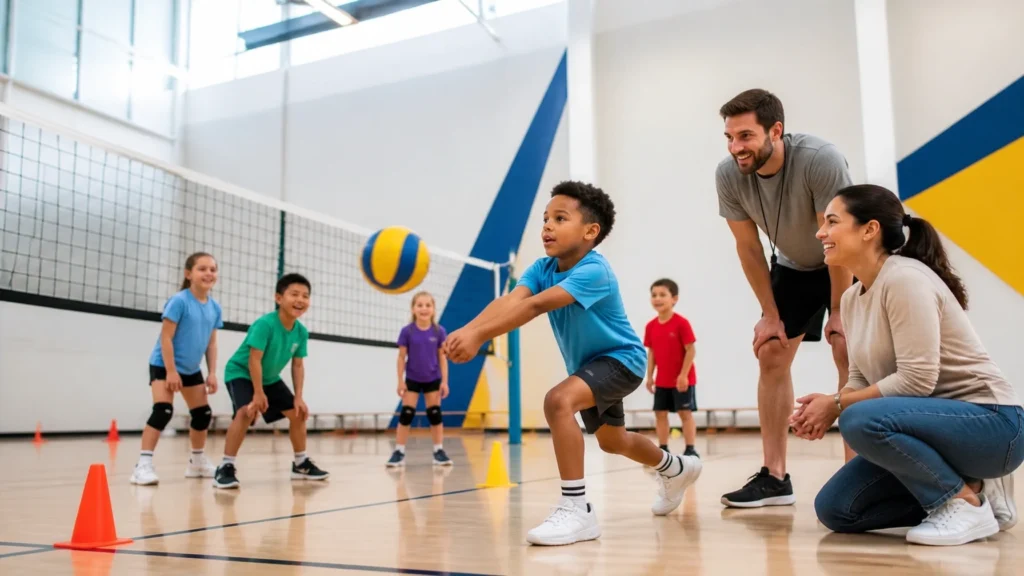
Volleyball is a team sport with big energy, colorful balls, quick laughs, and plenty of opportunities to yell, “Mine!” without starting a sibling argument. For parents looking for fun ways to introduce sports, volleyball for kids is a fantastic place to begin.
It teaches movement, coordination, communication, confidence, and teamwork. Best of all, children can start learning the basics before they ever join a formal team. With the right approach, a living room book, a coloring page, a simple game, or a backyard toss can become the first step toward a lifelong love of sports.
This guide explains how parents can use books, audio, puzzles, videos, and online games to make volleyball approachable, active, and educational.
Why volleyball is great for kids
Volleyball naturally encourages children to work together. Players must watch the ball, move into position, communicate with teammates, and make quick decisions.
For younger children, the goal is not perfect technique or powerful spikes. The goal is to build comfort with the ball and create positive first experiences.
Volleyball can help children develop:
- Hand-eye coordination
- Balance and footwork
- Listening and communication skills
- Confidence in trying new movements
- Teamwork and sportsmanship
- Focus and reaction time
- Basic understanding of rules and positions
This is the heart of youth sports education. Kids are not simply learning how to hit a ball. They are learning how to pay attention, practice, encourage teammates, and keep trying after a miss.
That last skill is important because every young athlete will eventually send a ball into the net, over the fence, or directly into a parent’s snack. That is not failure. That is practice with dramatic sound effects.
Start with the volleyball basics
Most beginner programs introduce four foundational skills: passing, setting, serving, and moving safely.
1. Forearm passing
Also called a “bump,” the forearm pass is often the first skill children learn.
Encourage your child to:
- Bend the knees slightly.
- Keep the feet comfortable and ready to move.
- Bring the arms together to create a flat platform.
- Contact the ball on the forearms, not the hands.
- Use the legs to guide the ball instead of swinging wildly.
Try a gentle parent-child activity. Stand a few feet apart and softly toss the ball toward your child. Ask them to pass it back to you. Celebrate a controlled contact, not just a perfect pass.
2. Setting
Setting uses the fingertips to send the ball upward and toward a target. Young players do not need to make every set look like a highlight-reel assist. They simply need to learn soft hands, body control, and direction.
Ask your child to make a small window shape above the forehead with the hands. Then practice catching and gently pushing a soft ball upward. This develops the feel of setting without making the activity too difficult.
3. Underhand serving
The underhand serve is a confidence-builder for beginners.
A simple sequence is:
- Stand with one foot slightly forward.
- Hold the ball in the non-dominant hand.
- Swing the other arm like a pendulum.
- Contact the ball with the heel of the hand or a closed fist.
- Step toward the target during the swing.
- Finish with the arm pointing forward.
Begin close to the net or use a lower training net. Success matters more than distance at this stage.
4. Movement and communication
Teach children to watch the ball, stay balanced, and call “mine” when they are going for it. Safe movement is part of learning the game.
Parents can also introduce a simple phrase: bump, set, send. For very young players, “send” may mean tossing the ball over the net rather than spiking it. The important thing is learning the rhythm of teamwork.

A simple volleyball learning plan for home
You do not need a full court or a whistle-blowing referee to help your child learn. A 10-minute practice can be enough.
Try this beginner routine:
Two minutes: Ball familiarization
Let your child hold, toss, catch, and bounce the ball. Ask questions such as:
- What color is the ball?
- Can you toss it and catch it?
- Can you clap once before catching it?
- Can you move under it safely?
Three minutes: Passing practice
Toss gently from a short distance. Focus on the platform and bent knees. Move farther away only when your child feels comfortable.
Two minutes: Setting practice
Have your child catch the ball above the forehead and push it upward. For older beginners, introduce a gentle fingertip set.
Two minutes: Serving practice
Use a short distance and a soft ball. Celebrate when the ball travels toward the target, even if it does not clear the net.
One minute: Teamwork challenge
Finish with a silly goal, such as completing three passes together. The challenge should feel achievable and fun.
This type of repetition is ideal for learn sports for kids programs because it combines physical activity with vocabulary, counting, direction, and decision-making.
The volleyball education system: learn it, hear it, color it, play it
Sports Media Inc.’s youth publishing approach is designed to meet children in more than one learning style. The volleyball education system can include:
Print book
A print book gives children a friendly introduction to the sport through characters, stories, pictures, and simple explanations. Let’s Play Volleyball! introduces young readers to bumping, setting, serving, rallying, teamwork, and sportsmanship.
Shop the volleyball print book
Audio book
An audio book or listening edition is useful during car rides, quiet time, bedtime, or classroom listening. Children can hear the story and sports vocabulary while imagining themselves on the court.
Explore the volleyball audio and digital edition
Coloring book
Coloring helps children slow down, notice details, and connect sports words with visual scenes. It is a great screen-free activity before practice, after a game, or during travel.
Get the volleyball coloring book
Puzzle book
A puzzle book reinforces vocabulary and observation through activities such as word searches, matching, mazes, and sports-themed challenges. It turns learning into a game, which is exactly how many kids prefer their education served.
Explore the volleyball puzzle book
Online game platform
Digital play can reinforce what children see in the books. Visit sportsmedia.us to explore sports content and online experiences designed to keep young fans engaged.
Video learning
Parents can also use the Sports Media Kids YouTube playlist for sports-themed videos and kid-friendly learning. Watch together, pause to ask questions, and then try a movement from the video in a safe space.

Turn screen time into active time
Online games and videos work best when they lead to real-world movement. After watching a volleyball video, ask your child to demonstrate one thing they remember.
Try prompts like:
- “Show me how a player gets ready to pass.”
- “Can you point to the part of your arms used for a bump?”
- “What should a teammate say when going for the ball?”
- “Can we count five safe tosses together?”
This creates a simple cycle:
Read it. Hear it. Watch it. Play it. Explain it.
That cycle makes children’s sports books more powerful because the lessons move from the page into action.
For younger athletes, keep sessions short and positive. A child who wants to play again tomorrow has already scored a major victory.
Parent tips for a positive first experience
The most helpful sports parent is not always the loudest one in the gym. Children benefit from encouragement that emphasizes effort and improvement.
Try these approaches:
- Praise hustle, focus, and communication.
- Let coaches handle technical corrections during team practice.
- Ask your child what they enjoyed.
- Avoid comparing their progress with another player.
- Keep equipment age-appropriate and easy to control.
- Use soft or lighter balls for beginners when possible.
- Make safety and personal space part of every activity.
- Celebrate small improvements.
A good question after practice is, “What did you learn?” A better follow-up may be, “What was the funniest thing that happened?” Both questions help children connect sports with positive memories.
Sponsors wanted: Help put educational games in kids’ hands
Sports Media Inc. is seeking sponsors for educational sports games and youth learning experiences. Sponsorships can help support volleyball content, online games, videos, books, activity materials, school resources, and family-focused sports education.
Sponsors can align their brands with:
- Active kids and healthy habits
- Youth sports education
- Family learning
- STEM-connected game development
- Community sports programs
- Future athletes and fans
- Positive teamwork and confidence-building
This is more than placing a logo on a screen. It is an opportunity to help children learn how sports work, discover new interests, and take their first step onto the court.
Contact Sports Media Inc. about sponsoring educational sports games
Frequently asked questions about volleyball for kids
What age is best to start volleyball?
Children can begin with basic tossing, catching, movement, and teamwork activities at a young age. Many introductory books and activities are especially suitable for children around ages 4 to 8, while formal team rules vary by program.
Should kids learn to spike first?
Usually, no. Passing, serving, setting, movement, and communication should come first. Power skills can be introduced gradually as children build strength, balance, and coordination.
How can parents teach volleyball without coaching experience?
Use simple activities, soft equipment, short practice sessions, and age-appropriate books or videos. Your job is to make learning enjoyable and safe. A local coach can provide more advanced technical instruction.
What makes volleyball a good learning sport?
Volleyball combines movement, counting, communication, teamwork, decision-making, and physical coordination. It is a fun way to blend active play with learning.
Volleyball is not just about getting the ball over the net. It is about learning how to move, listen, cooperate, practice, and try again. With the right mix of books, audio, coloring, puzzles, videos, online games, and real-world play, your child can build a strong foundation while having a ball.
Literally.
Disclosure: Some links in this article may be affiliate links. Sports Media Inc. may earn a commission at no additional cost to you.
#KidsSports #YouthSports #SportsBooks #LittlePro #LearnToPlay #SportsEducation #ParentingTips #ActiveKids