
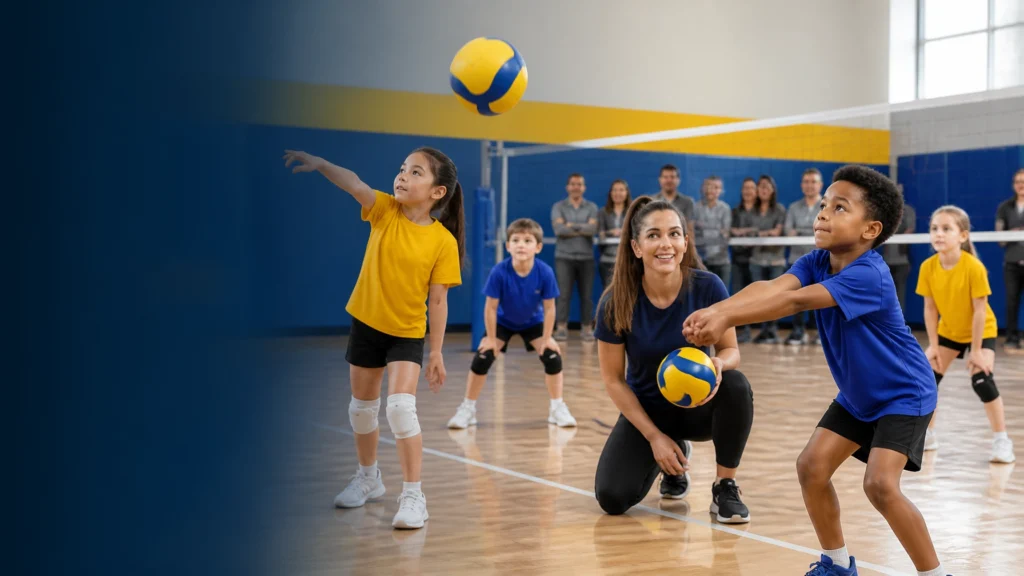
Volleyball is fast, social, and wonderfully forgiving. A child can learn to bump, set, serve, and cheer for a teammate before mastering every rule in the book. That makes it a fantastic starting point for youth sports education and an exciting way to help children build confidence, coordination, communication, and healthy habits.
The Let’s Play Volleyball! learning system from Sports Media Inc. takes that first lesson beyond the court. It combines stories, sound, creativity, puzzles, video, and interactive play so children can learn sports for kids in the way that feels most natural to them.
In other words, it is a volleyball curriculum with more energy than a pregame warmup and fewer whistles.
Why volleyball is a great first sport for kids
Volleyball teaches children how to move, listen, communicate, and work together. It also gives them repeated opportunities to try again. Missed the ball? Shake it off. The next rally is already waiting.
Young players can develop:
- Hand-eye coordination
- Balance and movement skills
- Spatial awareness
- Communication and teamwork
- Confidence and resilience
- Focus, sequencing, and decision-making
- Respect for coaches, teammates, and opponents
Because volleyball is a team sport, children quickly learn that success is not just about being the biggest or fastest player. A thoughtful pass, a loud “mine,” or an encouraging high-five can change the entire rally.
For parents, that is one of the best lessons in youth sports education: every child has a meaningful role.
The volleyball fundamentals children should learn first
Parents do not need to turn the living room into a coaching clinic. Start with a few simple ideas and make practice playful.
1. Passing, or bumping
Passing is often the first volleyball skill children learn. Kids bring their forearms together to create a flat platform, bend their knees, and use their legs to guide the ball toward a teammate.
A simple cue is:
“Platform straight, knees bent, move your feet.”
The goal is not perfect technique on day one. The goal is helping children feel comfortable contacting the ball.
2. Setting
Setting is an overhead pass that places the ball for a teammate. Children can imagine making a small triangle with their hands above their forehead. The ball should contact the fingertips, not the palms.
Try saying:
“Soft fingers, push the ball, do not catch it.”
If the ball flies sideways at first, congratulations. Your child has invented an exciting new sport called Living Room Volleyball.
3. Serving
Beginners usually start with an underhand serve. The child stands behind the service line, holds the ball in the non-dominant hand, steps forward, and swings the other hand like a pendulum.
The simplest sequence is:
- Step
- Swing
- Hit
- Follow through
A successful serve does not have to be powerful. It only needs to travel over the net and into the other court.
4. Rallying and teamwork
A rally is the back-and-forth action after the serve. Children learn that one player cannot do everything. The team may have up to three contacts to send the ball over the net, usually a pass, set, and attack.
At the beginner level, focus on keeping the ball moving and celebrating effort. The “perfect” rally is less important than the fun of creating one together.
5. Simple rules
As children become more comfortable, introduce a few basic rules:
- Each team gets up to three hits.
- A point can be scored on every rally.
- Players cannot catch, throw, or hold the ball.
- Players rotate when their team wins the serve.
- Players should avoid touching the net.
- Players should call the ball to prevent collisions.
For younger children, parents and coaches can modify the game with a lower net, a lighter ball, smaller teams, or one allowed bounce. The objective is to create more successful touches and fewer frustrated faces.
The USA Volleyball beginner’s guide is a helpful resource for families who want to explore the fundamentals, positions, equipment, and ways to play.
The complete Let’s Play Volleyball! education system
The Sports Media youth education model is designed for different learning styles and different moments in a child’s day. The full system includes six connected experiences.
1. Print book
Start with Let’s Play Volleyball!, a colorful storybook for young readers. Children meet Zoe, Mikah, puppy TT, Coach Dan, and Coach Bianca while learning how volleyball works.
The print book is designed for reading together at bedtime, in classrooms, at libraries, or before practice. It introduces bumping, setting, serving, teamwork, and sportsmanship through an approachable story.

2. Audio book
An audio version gives children another way to absorb the story. It works especially well during car rides, quiet time, or while getting ready for practice.
Listening helps children hear the language of the game and imagine the action. Parents can pause and ask questions such as, “What would you do if the ball came toward you?” That small conversation turns passive listening into active learning.
3. Coloring book
Let’s Color Volleyball! allows children to revisit the characters, court, net, and skills through creativity.
Coloring can support focus, fine motor development, and memory. It also gives kids a low-pressure way to connect with a sport before they ever join a team. There is no scoreboard, no tryout, and no need to color the volleyball realistic shades of white and blue. A neon-green volleyball is perfectly legal in the imagination league.

4. Puzzle book
The Let’s Play Volleyball Puzzle Book adds word games, challenges, and activities to reinforce sports vocabulary and concepts.
Puzzle activities can help children remember terms such as serve, pass, net, rally, teammate, and rotation. They also encourage problem-solving and pattern recognition, skills that connect naturally to classroom learning and STEM education.
5. Online game
The learning continues at sportsmedia.us, where children can engage with online sports games and interactive activities.
Digital play should not replace physical activity, but it can strengthen understanding before and after practice. A child might learn the difference between a pass and a serve online, then try both skills with a real ball.
For parents, the ideal rhythm is simple:
- Read the story
- Watch a short lesson
- Play a digital activity
- Practice one skill
- Celebrate progress
That is a complete learning loop without requiring a professional gym in the basement.

6. Video channel
Children can also watch the Sports Media Kids YouTube playlist for sports-focused video content.
Video helps bring movement and character learning to life. Parents can watch alongside their children, pause for questions, and then move from the screen to a backyard, driveway, gym, or beach court.
This multi-format approach is part of Sports Media’s broader youth education initiative, which is designed to help children discover sports through books, games, videos, and age-appropriate educational experiences.
A parent-friendly volleyball lesson plan
Try this 20-minute family session:
- Read for five minutes: Explore one section of the print book.
- Watch for five minutes: Use the video playlist to review a skill.
- Move for five minutes: Practice underhand tosses, forearm passes, or balloon rallies.
- Reflect for five minutes: Ask what your child learned and what they want to try next.
Use a balloon or soft volleyball for younger children. Keep the net low or use a piece of string between two chairs. Praise effort, communication, and improvement instead of counting every mistake.
The best youth sports education experiences make children feel capable. A child who says, “I want to try that again,” is already making progress.
Calling corporate sponsors: Help put youth sports education in more hands
Sports Media Inc. is seeking corporate sponsors for educational youth sports games and learning experiences available through sportsmedia.us.
Sponsorship can help brands support:
- Children’s sports books and educational publishing
- Digital learning games
- Safe, age-appropriate sports videos
- School, library, and community programming
- STEM education connections through sports
- Family engagement and active lifestyles
- Workforce development pathways built on teamwork, communication, and problem-solving
For companies looking to build a meaningful talent funnel, youth sports can be an authentic place to start. Children who learn to communicate, practice, solve problems, and support a team are developing habits that matter far beyond the volleyball court.
Corporate partners can explore branded educational games, sponsored content, community activations, school outreach, and other opportunities through Sports Media’s solutions. To discuss sponsorship opportunities, visit Sports Media’s contact page.
Frequently asked questions
What age is Let’s Play Volleyball! designed for?
The book listing identifies the digital edition as appropriate for children ages 4 to 8. Parents can adapt the activities for younger children or use the system as a fun introduction before organized play.
What are the first volleyball skills kids should learn?
Start with passing, setting, serving, movement, and communication. Keep drills short, use soft equipment when needed, and focus on frequent successful contacts.
Can children learn volleyball without joining a team?
Yes. Children can begin with stories, videos, puzzles, balloon rallies, and simple backyard games. Organized programs can come later when a child is ready.
Why use books, games, and videos together?
Each format supports a different learning style. Reading builds vocabulary, audio encourages imagination, coloring supports creativity, puzzles reinforce concepts, games add interaction, and videos demonstrate movement.
Ready to bump, set, and serve?
Volleyball is more than a sport. It is a classroom with a net, a ball, and plenty of opportunities to practice teamwork.
Explore the Let’s Play Volleyball! book, add the coloring book and puzzle book, watch the Kids YouTube playlist, and visit sportsmedia.us for interactive play.
Disclosure: Some links in this article are Amazon affiliate links. Sports Media Inc. may earn a commission from qualifying purchases, at no additional cost to you.
#KidsSports #YouthSports #SportsBooks #LittlePro #LearnToPlay #SportsEducation #ParentingTips #ActiveKids #VolleyballKids